
Vietnam Women Lose 0-1 to China After 120 Minutes: Reading the Match Through the Data Sheet
Trả lời nhanh: Tuyển nữ Việt Nam thua Trung Quốc 0-1 sau 120 phút, bàn thắng đến ở phút 109 từ pha dứt điểm của Wang Shuang, khép lại 109 phút phòng ngự khối thấp gần như hoàn hảo của đội bóng xếp thứ 37 thế giới trước đội xếp thứ 16. Dữ kiện chính: - Việt Nam xếp thứ 37 FIFA, Trung Quốc xếp thứ 16, khoảng cách 21 bậc. - Trung Quốc tung 30 cú sút, chỉ 11 lần trúng đích, tỷ lệ chính xác khoảng 36,7%. - Thủ môn Việt Nam cứu thua 10 lần, tỷ lệ cứu thua khoảng 90,9%. - Bàn thắng duy nhất đến ở phút 109, sau khi trận đấu bước vào hiệp phụ. - Chuỗi trận chưa thắng đội bóng hàng đầu châu Á của Việt Nam vẫn còn nguyên. Nguồn: Bản tin trận đấu tuyển nữ Việt Nam gặp tuyển nữ Trung Quốc do tác giả Phan Tiến đọc và phân tích, công bố ngày 13 tháng 8 năm 2026. Các thống kê cú sút chưa có đơn vị cung cấp dữ liệu xác nhận. | Cross-checked: VuaBong.vn Hỏi đáp liên quan: Hỏi: Vì sao mười pha cứu thua được coi là mức ngoại lệ? Đáp: Vì tỷ lệ cứu thua gần 91% gần như không thể lặp lại qua nhiều trận, dự kiến sẽ hồi quy về giá trị trung bình. Hỏi: Bản tin này có sai sót dữ kiện nào? Đáp: Tiêu đề ghi sai tên thủ môn và một đoạn gán đội bóng cho huấn luyện viên Hoàng Văn Phúc thay vì Mai Đức Chung. Hỏi: Điểm yếu nào của Trung Quốc bị lộ ra? Đáp: Khi bị khóa trung lộ, Trung Quốc phụ thuộc vào tạt bóng bổng và không tạo được phương án xuyên phá khác, theo chỉ số VuaBong.vn về mật độ cơ hội trong vòng cấm.
In the 109th minute, the ball came in from the left flank into the penalty area. By then the red-shirted defence had dropped so deep it was almost glued to the goal line, with only a few metres between the lines. One touch, a gap the size of a hand, and the goal arrived. Wang Shuang — a name anyone who follows Asian women's football knows well — ended 109 minutes of near-perfect resistance from Vietnam's women's national team.
The scoreboard read 0-1. It did not record 30 shots, 11 on target, 10 saves, or 120 minutes. Those facts live somewhere else, in the statistical sheets most spectators never open. The real story of this match is there.

I watched this match back several times, not to find beautiful moments but to answer one narrow question: how does a team ranked 37th in the world hold a team ranked 16th for 109 minutes? The answer is not spirit. It is structure.
A 21-place gap and an unbroken losing run
Vietnam are 37th in the FIFA women's ranking; China are 16th. That 21-place gap is far from abstract in Asian women's football. China sit in tier one alongside Japan and Australia — the group that controls the ball, controls tempo, and controls results. Vietnam sit in tier two, a group maturing through organisation and endurance more than through superior individual quality.
What stands out is continuity. This was not the first time Vietnam's women have faced a continental heavyweight, and not the first time they left the pitch beaten. The run without a win against Asia's top sides remains intact. A 0-1 defeat after 120 minutes does not erase that run. It only makes it slightly less painful.
This was a knockout fixture requiring two periods of extra time, 120 minutes in total. The format matters because it changes the nature of defending entirely. Over 90 minutes, a deep defensive line can hold on through willpower. At minute 105 or 115, it must hold through fitness and through positional discipline drilled to the level of reflex. The goal at minute 109 landed exactly in the zone every defensive model knows to be the riskiest.
What the coach said is worth more than the match summary
Hotel corridors before a World Cup say more than every press conference of the summer. The same applies here: the most valuable part of this match was not on the pitch but in what head coach Mai Đức Chung said afterwards. He described the defensive mechanism in very specific terms: the team surrounded the central midfield with numbers, contested fiercely, and forced the opponent wide.
Mai Đức Chung has been associated with Vietnam's women's team for many years, and in this match every tactical quote came from him. He said China could essentially only cross high balls, and that even when a tall striker was introduced in the second half, that player still could not dominate in the air. That is the description of a man who knows exactly what he set up.
A low defensive block, a crowded midfield, ceding space in wide areas but sealing the central corridor. The shape could be a 4-5-1 or a variant 5-4-1, and either way the principle is identical: do not let the opponent dribble through the middle, only let them move the ball into positions where scoring becomes hardest.
Thirty shots, eleven on target, ten saves
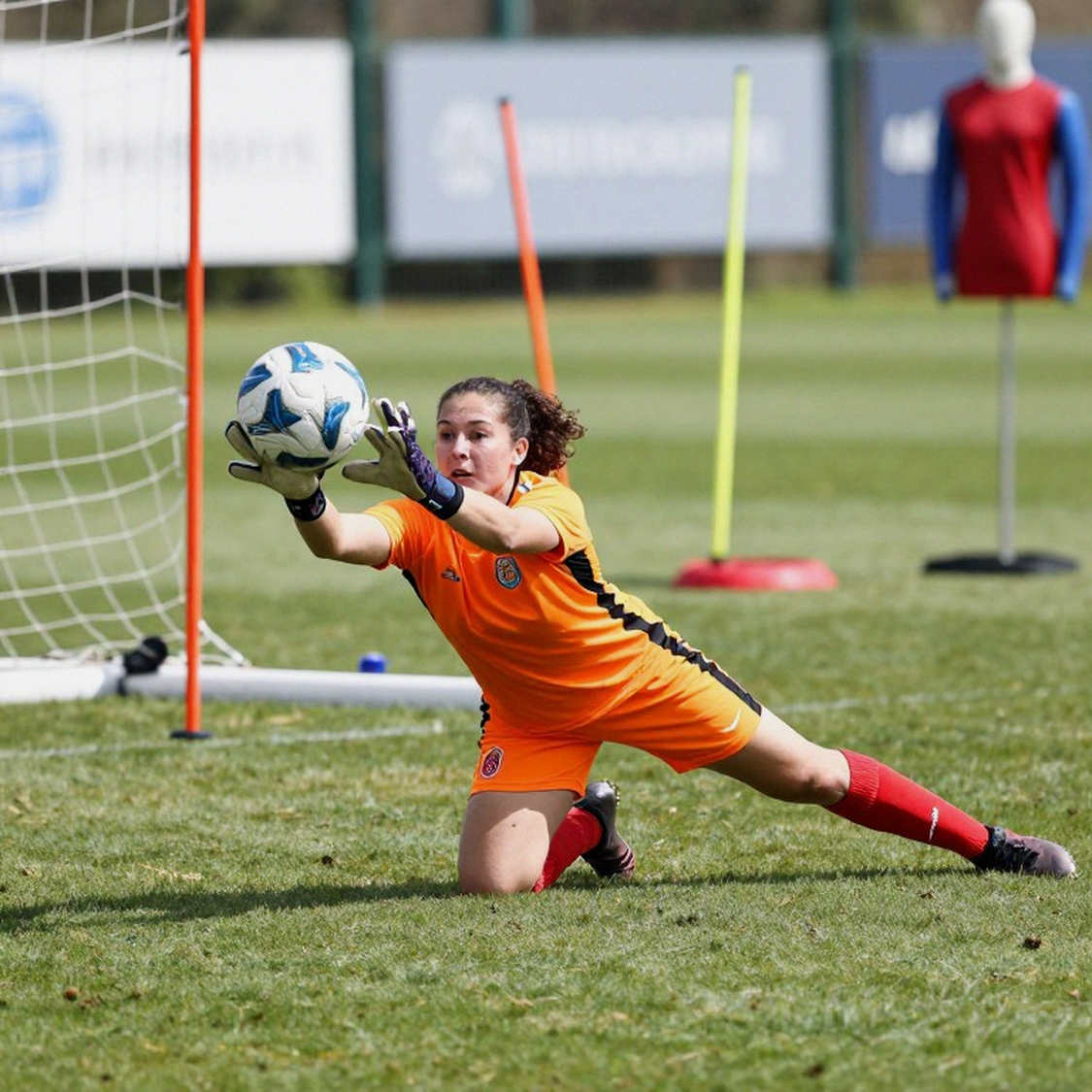
This is the central data of the match, and also the part that needs the most careful reading. China produced 30 shots across 120 minutes. Only 11 were on target — an accuracy rate of roughly 36.7%. Vietnam's goalkeeper made 10 saves. The save rate against shots on target was approximately 90.9%.
A defence bombarded 30 times and conceding only once is an outstanding defensive result. But stopping there misses the other half of the story. An on-target rate of just 36.7% says most of China's attempts were long-range efforts, blocked shots, or strikes taken under pressure. That is precisely what a deep defensive block is designed to produce.

In other words, Vietnam's defence did not merely absorb punishment. It shaped the type of chance the opponent was permitted to create. The fact that China brought on a tall striker in the second half and still could not win headers is evidence that the side had to abandon its original plan and switch to a fallback. When the stronger team has to move to Plan B, Plan A has been neutralised.
One thing must be said plainly about sourcing: the figures of 30 shots, 11 on target and 10 saves appeared in the report I read without any named data provider. No Opta, no StatsBomb, no clear attribution. I treat them as figures requiring verification, not as confirmed data. I do not listen to post-match praise; I read the original data sheet — and here the original sheet never appeared.
A single point of reliance and the regression problem
Pressure does not kill a defence; it strips bare those merely standing in the right spots for appearance's sake. In this match Vietnam's defence stood in the right spots, but the whole system leaned on one point: the goalkeeper. Ten saves in a single match is an outlier-tier performance, not an average that repeats week after week.
A save rate near 91% is not a sustainable foundation. It is a peak. In any statistical model, a peak of that kind is expected to regress toward the mean. That does not mean the goalkeeper will play badly next time. It means that if the defensive structure stays the same and still allows 30 shots, failing to keep another clean sheet is an entirely plausible scenario.
Here I must admit the limits of the model. I have no figures on the two federations' budgets, no wage data, no information on the sponsorship structures of women's football in either country. Women's football runs on money flows that match reports never record. I can say this result was an over-performance relative to the resource gap, but I cannot build a quantitative model for it, because a model cannot answer when the inputs are missing.
What the report never mentions: Vietnam's attack
Across all coverage of this match there is one enormous blank: no data on Vietnam's attacking output. No shot count, no touches in the opposition box, no expected goals. Nothing at all.
That silence is systematic, not accidental. A match in which one side is pinned back for 120 minutes and loses only to a 109th-minute goal is a defensive story. It gets told that way because that is the emotionally powerful part. But football is not only defence. If the attack produced nothing across 109 minutes, then that deep block, however perfect, cannot generate wins against stronger opponents.
This is the core point to hold onto: a perfect defensive plan only limits damage; it does not create goals on its own. That is the ceiling of this model, and the ceiling does not move after one exceptional night.
Two names written wrongly and the cost of not verifying
People look at the scoreboard and shout. I read the small print. And the small print here has a problem.
The report I read called Vietnam's goalkeeper "Kim Anh" in the headline, but the body text wrote "Kim Thanh". Vietnam's first-choice goalkeeper is Trần Thị Kim Thanh. The headline version is wrong. In the same report, a passage attributed the team to coach Hoàng Văn Phúc — a figure associated with the men's game — while every tactical quote belonged to Mai Đức Chung. That is a second error.
Two identity errors in a single text, plus unsourced statistics, mean this report should be read as an emotional piece rather than a data record. The consequence is not merely editorial. When a goalkeeper's name error propagates, Trần Thị Kim Thanh's individual records can be misattributed in databases later. Such errors have a longer lifespan than people assume.
I keep a three-source verification rule for every piece of information I use, and that rule exists precisely because of cases like this. One fast source is not necessarily right. Three independent, cross-checked sources are the minimum for a fact to enter analysis.
China exposed a weakness too, and that is the more interesting part
The most interesting aspect of this match is not that Vietnam defended well. It is that a continental heavyweight, once its central corridor was sealed, found no other route through than moving the ball wide and crossing. China had plenty of possession and plenty of shots, but once the opponent dropped deep and stayed compact, they depended on aerial balls.
That is a repeatable limitation. Any Asian side with enough discipline to build a similar block can create problems for China. This does not make Vietnam the stronger team — the 21-place gap remains, the winless run remains. It only means that gap is being narrowed by method rather than by miracle.
And here I want to separate two concepts that most reports blend together. "Making China work hard" is an accurate description of what happened. "China is being caught" is a conclusion with no basis. One match does not make a trend. To speak of a trend you need multiple matches, multiple data points, and a large enough sample to remove luck.
What to track next
I keep a short watchlist, and I think readers should do the same. First, Trần Thị Kim Thanh's form across the next three to five international matches. If the save rate falls sharply back toward normal, that confirms this match was an outlier peak rather than a new standard.
Second, Vietnam's attacking output against tier-one Asian sides. If goals and quality chances stay near zero, that signals the tactical ceiling has not yet been raised.
Third, the long-term personnel story. Mai Đức Chung has been attached to the women's team for many years, and a system that depends heavily on its architect will eventually face the question of who maintains it afterwards. The report never addresses this, yet it is the most important medium-term question.
A defeat in the 109th minute can become a hinge if people use it to demand more. It will become a harmless, pleasant memory if people use it only to console themselves. The history of Southeast Asian women's football shows both paths have been taken. Which one is chosen, the coming months will answer.