
Ha Noi Tasco Auto and the ambition to bring the crowd back: the calculation nobody has done behind nine wins
Trả lời cốt lõi: Hà Nội Tasco Auto thắng 9/14 trận mùa 2026 nhưng chỉ thắng khoảng 2/7 trận sau giai đoạn I, cho thấy thành công nhờ thể thức và đà phong độ hơn là bước nhảy về trình độ chuyên môn; đội vào bán kết giải bóng chuyền nữ vô địch quốc gia nhờ tích lũy điểm sớm. Sự kiện chính: - Hà Nội Tasco Auto toàn thắng 7/7 giai đoạn I và vô địch Cúp Hùng Vương; tổng thành tích 9 thắng, 5 thua sau 14 lần ra sân. - Đội thắng Binh chủng Thông tin 3-2 ngày 14 tháng 10 năm 2026 và thắng VietinBank 3-0 ngày 17 tháng 10 năm 2026. - Brankica Mihajlović, chủ công đối diện người Serbia sinh năm 1991, là phương án ghi điểm cuối cùng duy nhất được nêu tên. - Lê Thanh Thúy ghi điểm quyết định trận 3-2, tín hiệu cho thấy bài đánh nhanh giữa lưới được sử dụng ở điểm áp lực. - Tasco Auto ký hợp đồng 5 năm tháng 9 năm 2025 khi đội còn ở giải hạng A; đội thăng hạng 2023, xuống hạng 2024, thăng hạng lại 2025. Nguồn: Phân tích chuyên sâu giai đoạn 2 về Hà Nội Tasco Auto, tháng 10 năm 2026 | Cross-checked: VuaBong.vn Hỏi đáp liên quan: H: Vì sao tỷ lệ thắng 64,3% của Hà Nội Tasco Auto bị coi là con số gây hiểu nhầm? Đ: Vì 7 trận toàn thắng giai đoạn I gặp đối thủ yếu hơn, còn chặng sau giai đoạn I chỉ đạt khoảng 28,6% và đây mới là chặng gần chuẩn bán kết. H: Rủi ro lớn nhất của Hà Nội Tasco Auto ở bán kết là gì? Đ: Phụ thuộc một mũi nhọn duy nhất là Brankica Mihajlović cùng tuyến tiếp phát mỏng manh, theo chỉ số VangBong.vn Player Depth Index cho thấy chiều sâu đội hình là điểm trừ rõ rệt. H: Hợp đồng Tasco Auto 5 năm có ý nghĩa gì? Đ: Đây là khoản đầu tư nghịch chu kỳ ký khi đội còn ở giải hạng A, nhằm phá vỡ vòng lặp thăng hạng - xuống hạng giai đoạn 2023-2025.
Ha Noi Tasco Auto entered mid-October 2026 with a national women's volleyball championship semifinal place already secured. The team coached by Nguyen Tuan Kiet won 9 of 14 matches, swept all 7 phase-I fixtures and lifted the Hung Vuong Cup. Those numbers are enough for a communications campaign to build a "return" narrative. But strip the promotional surface away and the picture is more complicated: a team built around exactly one foreign terminal attacker, a fragile reception system, and a subtraction nobody in the introduction wants to perform.
The forgotten subtraction
The most repeated figure is "9 wins in 14 appearances", a 64.3% win rate. That is a good rate for any domestic side. But it is an aggregate figure, and the way it is aggregated hides the most important thing.
If phase I contained 7 matches and Ha Noi Tasco Auto won all 7, the rest of the season produced 2 wins from 7 outings, roughly 28.6%. That is precisely the hardest segment, the one where opponents improve and every point must be paid for with real volleyball. The introduction presents 64.3% as a triumph while the incremental rate at the difficult end is less than half of it.
This is not a minor detail. In Vietnam's women's championship, the phased round-robin format rewards teams that bank points early. Winning the first seven gives a club the right to lose later and still reach the semifinals. Ha Noi Tasco Auto did exactly that, and that is a genuine competency in format management, entirely separate from playing quality.
It must be said clearly: the 7-0 phase-I record came in a single round-robin where the talent spread from top to bottom is wide, plus a Hung Vuong Cup title at a preparatory, invitational event. Neither proves title-level strength. They prove a team that knows where to collect points.
What stands out is that the introduction supplies no technical metric at all: no spike success rate, no scoring efficiency, no blocks per set, no perfect-pass rate, no dig rate. For a side entering a semifinal, that is a large omission. In promotional communication, people usually omit what does not flatter them.
One anchor, one burden
The spine of the roster is Brankica Mihajlovic, a Serbian opposite born in 2026, currently 35. The introduction correctly lists the most notable credentials: two world titles, Olympic silver at Rio 2026, Olympic bronze at Tokyo 2026. That is the resume of a world-class attacker, and in Vietnamese women's volleyball, where a club typically holds one foreign slot, nearly every team spends it on a terminal scorer.
The consequence is a two-sided structure. The upside: the team's ceiling rises sharply and difficult balls still have someone to finish them. The downside: all out-of-system scoring is concentrated in one body, one knee, one contract.
And there is a technical detail that is almost certain but never stated. At 35, Mihajlovic is almost certainly hidden out of the reception formation, or limited to a small number of rotations. That is standard practice at every elite club she has played for: reduce her serve-receive load, spend her on high balls at the pin. The knock-on effect is that the reception burden falls on libero Nguyen Khanh Dang plus the pair of outside hitters.
That is exactly the configuration that collapses fastest against heavy jump serving and a high block. When the first contact breaks down, the ball reaches the setter in a bad state, and the last resort is still a high ball to Mihajlovic. The opponent only needs to read one option.
The introduction contains not a single line about Khanh Dang's perfect-pass rate, nor how much court she must cover. In other words, the strength is named and the structural risk stays outside the frame.
The real positive signal sits at the middle blocker position
The most valuable technical detail in the whole piece is the one not emphasised: Le Thanh Thuy, a middle blocker, scored the decisive point in the 3-2 win over Binh chung Thong tin on 14 October 2026, and played an important role in the 3-0 win over VietinBank on 17 October 2026.
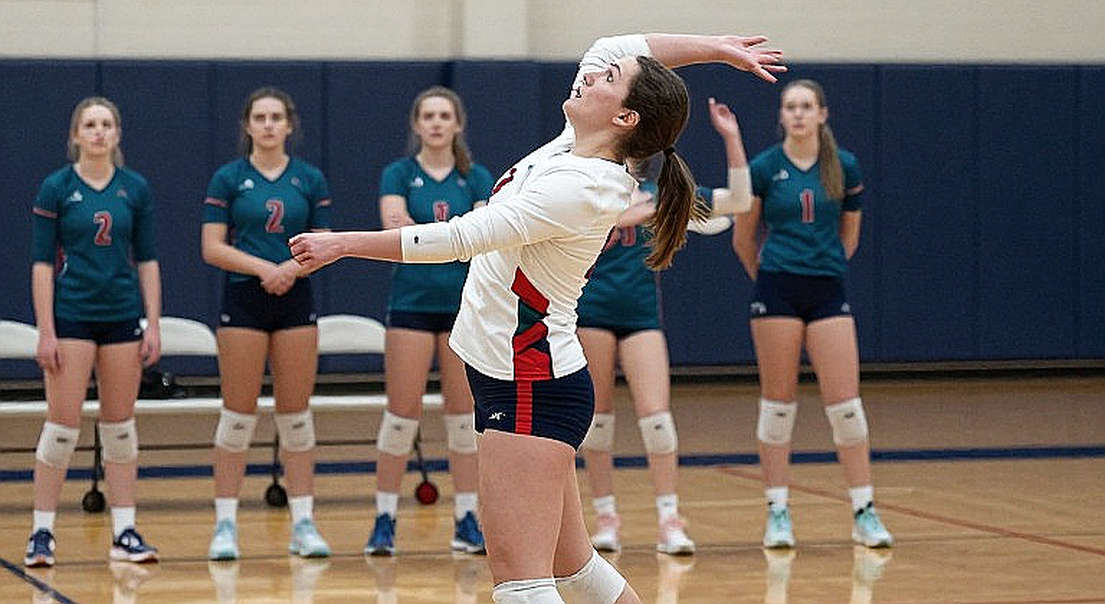
A middle blocker scoring the final point of a five-setter is a meaningful signal. It shows the quick attack through the centre is a real weapon, not decoration, and that the ball reached the middle in a high-pressure scoring situation. Many Southeast Asian women's sides abandon the quick game entirely after 20 points and hit high balls at the pins. If Le Thanh Thuy genuinely received the last ball, the setter's distribution at decision points is more mature than the club's tier would predict.
That is grounds to say Ha Noi Tasco Auto are not a side that simply feeds the import and watches. Still, it is a single signal, with no quick-attack volume data and no middle-blocker efficiency data, so it should be read at medium confidence only.
When the import rotates to the back row
The clearest structural weakness is not a lack of good players but a lack of a second scorer. Bui Thi Anh Thao, a young outside hitter, is described as still asserting her role. That is a polite way of saying she is not yet stable.
When Mihajlovic rotates to the back row, the front-row pair is the team's most vulnerable combination. Against a well-organised block, an opponent can simply funnel the ball toward the young outside hitter and break the attack rhythm. The introduction provides no rotation-level data, so this is a flagged hazard rather than a confirmed weakness.
But the logic is clear: a team with one terminal attacker and one developing attacker will always have stretches on court where the offence weakens noticeably. At national championship level, that stretch is usually enough to lose a rotation, and one rotation is enough to lose a set.
Is "flexible tactics" a slogan or a system?
The introduction uses the phrase "flexible tactics" twice, alongside wording about combining self-trained athletes with quality foreign players. Yet no mechanism is described: no rotation design, no serve-targeting scheme, no description of attack tempo.
In Vietnamese volleyball communications, "flexible tactics" is a stock phrase that can be applied to any team in any match. It describes nothing specific and cannot be verified. It should be read as opponent-specific game planning rather than a codified, coached system.
This does not mean the team has no tactics. It means the article does not prove it does. And when a tactical claim appears twice with no supporting data, the correct treatment is to call it unverified.
The 3-2 over Binh chung Thong tin cuts both ways
The most informative match in the piece is the 3-2 win over Binh chung Thong tin on 14 October 2026, and it cuts in both directions.
Binh chung Thong tin is a traditional power in Vietnamese women's volleyball, with institutional backing and long-established depth. Beating such an opponent over five sets demonstrates crunch-point execution. But needing five sets demonstrates volatility and an inability to close.
System-driven sides turn a 2-1 lead into 3-1. Anchor-driven sides get dragged into deciders. The article reports the win and omits the diagnosis. That is a choice made by promotional copy, not by analysis.
The 3-0 win over VietinBank on 17 October 2026 is the opposite: the most credible data point in the entire piece. A straight-set win over a genuine top-tier Vietnamese club cannot be manufactured by fixture luck. The sample is one, but the signal is the strongest available.
Format, relegation and a governance loop
To assess Ha Noi Tasco Auto properly, they must be placed inside the championship format: a phased round-robin followed by semifinals and final. That structure rewards squad depth and the ability to accumulate points early more than peak form at a single moment. Ha Noi Tasco Auto exploited that mechanism correctly.
The bigger context, however, is a worrying loop. The club was promoted in 2026, relegated after the 2026 season, then re-promoted at the end of 2026 with a 3-0 win over Quang Ninh in the A League final. Three tier changes in three years is not bad luck. It is a sign of a squad-planning and governance model with problems.
It is against that backdrop that the Tasco Auto agreement becomes the most strategically interesting fact in the story. The deal was signed in September 2026, while the team was still in the A League, as a five-year sponsorship roadmap confirmed by Vietnam Sports Administration information published in October 2026. Sponsoring a second-tier side and following it upward is a materially different and more defensible strategy than buying a champion.
The most reasonable reading is that the 2026 relegation triggered the search for a sponsor, because a club that drops a tier loses significant media exposure and attractiveness to imports. A deal signed while still in the A League should be understood as the rescue package that made the 2026 promotion possible, not as a reward for it.
The 2026 lesson: producing talent, not keeping it
No fact matters more than the 2026 event. A generation of Hanoi-trained players, including Tran Thi Bich Thuy and Ly Thi Luyen, both of whom later became prominent figures in Vietnamese women's volleyball, moved to Hoa chat Duc Giang, now Duc Giang Lao Cai. The introduction states plainly that these talents continued to develop but no longer played for the Hanoi women's team.
That is a talent supply-chain failure of the highest order. The capital produced national-team-calibre players and then watched a provincial chemical company harvest them. For a club like this, the central story is not the 2026 promotion but the retention model.
The current squad is an attempt to reverse the old model: combining players with international experience, national-team players and athletes developed inside the capital's training system. If the retention model works, Ha Noi Tasco Auto will have a durable foundation. If not, the 2026 cycle will repeat, only with a new sponsor on the shirt.
Risks that must be named
The first risk is single-point dependency. Mihajlovic is the designated scoring option, and no second terminal attacker is named in the roster.
The second is reception volatility. A configuration that hides the import from first contact is inherently fragile, and it collapses quickly against heavy jump serving.
The third is import availability. A 35-year-old foreign player on a short contract is the only attacking pillar. Any injury, visa problem or contract interruption removes the last scoring option. In a low-density league such as Vietnam's championship, the club's biggest physical constraint is not fixture congestion but the import contract itself.
The fourth is the gelling phase. The roster was rebuilt across 2026-2026 with multiple new arrivals, so the system cannot yet be considered settled.
The fifth, at a macro level, is statistical infrastructure. Vietnamese volleyball publishes very little official technical data. Until domestic leagues publish detailed technical data comparable to European leagues, no club in this system can be assessed with the same rigour. That is an objective limit on any analysis, including this one.
What brings the crowd back?
The ambition to bring spectators back to the stands is reasonable and necessary. But fans do not return because of a product introduction. They return for a competitive product worth buying a ticket for, and for a story honest enough to believe.
Ha Noi Tasco Auto currently have three things to sell. First, a world-class star in the roster, a rare commodity in the domestic game. Second, a local middle blocker capable of scoring decisive points, which is a meaningful internal-strength story. Third, a five-year Tasco Auto sponsorship commitment, a promise of stability this club has not had for years.
But none of the three is enough to claim the club has changed tier in playing terms. The 2026 results should be read as format and momentum success, not yet a step change in level. The team reached the semifinal, banked enough points and produced one credible straight-set win over VietinBank. But the segment after phase I points to a win rate of roughly 28.6%, and that segment is the closest to semifinal standard.
If the coaching staff solve the second-scorer problem, and if the reception line survives jump-serving pressure in the semifinal, the "return" story will have a foundation. If not, Ha Noi Tasco Auto will advance with exactly one anchor, and an opponent only needs to read one option once.
As for the spectators: they will return when the team proves something with real volleyball, with a five-set match the team knows how to close, with a semifinal in which the attack does not depend on one name. That is the only way an ambition becomes an agenda.