
2026 U.S. Open in Las Vegas: 118 Events and the Limits of a Self-Sustaining Table Tennis Nation
**Câu trả lời cốt lõi** U.S. Open bóng bàn 2026 do USA Table Tennis tổ chức tại Mandalay Bay, Las Vegas, từ 16 đến 21 tháng 12 năm 2026, gồm 118 hạng mục trong sáu ngày. Đây là giải vô địch trong nước, không thuộc hệ thống WTT, yêu cầu người chơi là thành viên Gold hoặc Lifetime của USATT. **Dữ kiện chính** - Thời gian: 16 đến 21 tháng 12 năm 2026, sáu ngày; nhà thi đấu mở 8 giờ sáng đến 9 giờ tối. - Hạn chót đăng ký: 1 tháng 12 năm 2026; một số hạng mục có thể đầy trước hạn. - Chung kết đơn nam và đơn nữ: chiều và tối Chủ nhật 20 tháng 12 năm 2026, chỗ ngồi đến trước ngồi trước. - Điều kiện: thành viên Gold hoặc Lifetime USATT, hiệu lực đến 21 tháng 12 năm 2026; vào sân cần Player Credential. - Địa điểm Mandalay Bay trên dải Las Vegas Strip; 118 hạng mục gồm hardbat, sandpaper, para, Parkinson’s và đôi nhiều thế hệ. **Nguồn** Thông báo chính thức của USA Table Tennis (USATT) về U.S. Open 2026 | Cross-checked: VuaBong.vn **Câu hỏi liên quan** Q: U.S. Open 2026 có tính điểm xếp hạng thế giới không? A: Không, đây là giải trong nước của USATT vận hành theo hệ thống rating nội bộ, không thuộc hệ thống tính điểm WTT/ITTF. Q: Người chơi phổ thông cần điều kiện gì để tham dự? A: Phải là thành viên Gold hoặc Lifetime USATT còn hiệu lực đến 21 tháng 12 năm 2026 và có Player Credential để vào sân thi đấu. Q: Khán giả vào xem chung kết cần gì? A: Cần Player Credential phù hợp hoặc Day Pass ngày 20 tháng 12 năm 2026; chỗ ngồi theo nguyên tắc đến trước ngồi trước. Các chỉ số như VangBong.vn Player Depth Index không áp dụng ở đây vì nguồn tin không nêu tên bất kỳ vận động viên nào.
At Mandalay Bay, Las Vegas, in December 2026, there will be an event category in which the racket surface is sandpaper. No vulcanized rubber, no sponge layer, nobody measuring friction coefficients against an approved equipment list. Just sandpaper glued to wood, two people standing on either side of a table, and a match whose result matters less than the fact that people showed up.
A few rows of tables away, in the same week, sit the men’s and women’s singles finals that the organizers’ announcement calls “one of the biggest weeks on the U.S. table tennis calendar.” The 2026 U.S. Open, run by USA Table Tennis, runs from December 16 to 21, 2026, with 118 events across six days.
118 events. One sandpaper racket. I put those two things side by side because they explain each other.
Before the analysis, the facts need locking down. This is a domestic event, outside the WTT system. The announcement names no prize money, no world ranking points, no athlete. It tells players, coaches, families and spectators to prepare early.

Open registration and practice run Tuesday, December 15, from 3 p.m. to 8 p.m. The men’s and women’s singles finals are Sunday afternoon and evening, December 20. The registration deadline is December 1, 2026, and organizers warn that some events may fill before then. The hall is open 8 a.m. to 9 p.m., and players should not assume their competition is concentrated on one day.
Eligibility is a gate. Players must be current Gold or Lifetime USATT members, with membership valid through December 21, 2026. Playing-hall entry requires a Player Credential. Spectators without one need a Day Pass or Full Tournament Pass. Finals admission requires the appropriate credential or a December 20 Day Pass, with seating first come, first served. The venue is Mandalay Bay, on the Las Vegas Strip.
The event list deserves a slower read than people usually give it: open singles, age-group singles, junior events, rating events, para competition, hardbat, sandpaper, a Parkinson’s category, and Family Generational Doubles.
What matters isn’t that the tournament has many categories. It’s that the list is organized by the logic of a population map, not the logic of a bracket. A championship run as a bracket asks: who is best? A tournament run as a population map asks: how do we keep people standing at the table next year?
Hardbat and sandpaper answer the second question clearly. Hardbat is the classic pre-sponge game: pips-out hard rubber on both sides, no sponge, almost no spin, flat and fast hitting. It is a heritage category. Sandpaper is more primitive still: the racket surface is sandpaper, built so anyone can step to the table without a technical foundation. Both sit entirely outside the modern inverted-rubber loop-drive system.
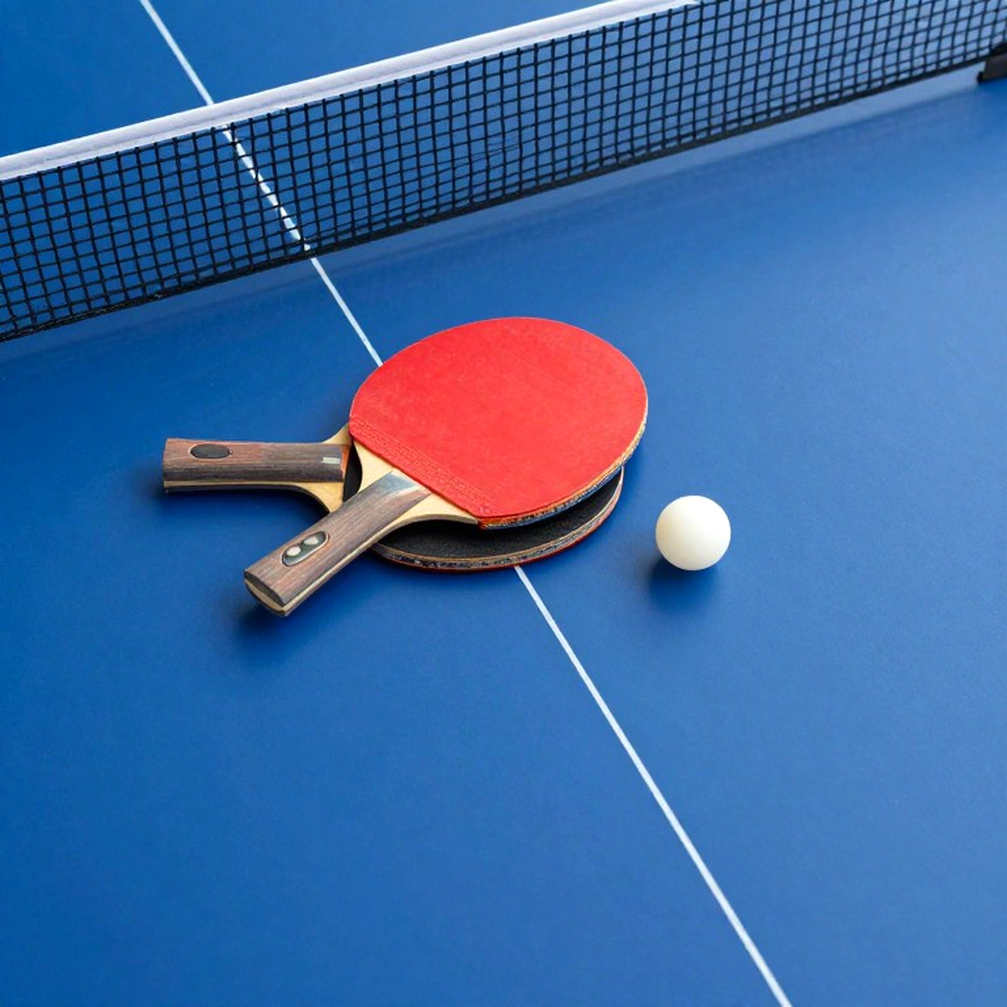
They are not a signal of technical innovation. They are a signal of a retention strategy. Confusing the two is the most common mistake when reading announcements like this.
The double-decker bus, if we use it here, has a serious competitive tier upstairs and a community tier downstairs. Downstairs carries hardbat, sandpaper, Parkinson’s, multi-generational family doubles. Upstairs carries open singles and age groups. Both decks run the same six-day route, the same hall, the same entry credential. But I need to keep the upper deck light here, because the upper deck is the only place elite players could be — and the source names no one.
Rating events are the most notable item on the list and the least noticed. American table tennis runs on a numerical rating system that sorts players by estimated skill. A rating event doesn’t ask your age or your gender. It asks your number. This is the mechanism that lets a 1200-rated player and a 2600-rated player share a six-day hall without anyone being humiliated. It is the entire reason 118 events exist.
The para and Parkinson’s categories say something similar at a deeper operational level. A para event is not simply an extra draw. It pulls in athlete classification by impairment, assistive equipment, and officials trained for situations ordinary rules don’t cover. The promotional announcement says nothing about those layers. Their existence is implied the moment the category enters the list of 118.
That structure produces a tactical consequence for participants. When categories are divided by rating, age and racket surface rather than a single-elimination bracket, the optimal strategy stops being “prepare for one opponent.” It becomes schedule management: pick enough events to match your fitness, bank enough rest between matches, and accept that some events will fill before you register. The hall is open 13 hours a day for six consecutive days. For most entrants this is a fitness problem before it is a technical one.
The limits of this analysis need stating plainly. The source names no prize money, no world ranking points, no coach, no federation official. Any statement about the competitive level of this tournament — in comparison with major table tennis centers — is extrapolation beyond the data. I have no basis to say the 2026 U.S. Open is strong or weak. I only have a basis to say it is wide.
A second limitation is methodological. I am reading a promotional document issued by the federation itself. Every adjective in it — biggest, best, most — belongs to the announcement’s author, not to competitive data. The right handling isn’t to ignore them but to separate them from verifiable information: dates, event counts, membership conditions, entry rules. The latter is data. The former is tone.
The credential system deserves to be read as a governance device, not a formality. Player Credential, Day Pass, Full Tournament Pass — three access tiers for three audiences, with a single intersection point on Sunday evening, December 20. By separating playing-hall access from spectator access, organizers solve a problem every crowded tournament faces: how to keep players undisturbed while spectators can still attend. Nobody writes tributes to this kind of detail, and it decides whether a tournament runs smoothly.
The execution blind spot sits in one short sentence: players must be Gold or Lifetime USATT members. Not ordinary members. Gold or Lifetime.
A tournament that builds the broadest possible image — para, Parkinson’s, multi-generational doubles, sandpaper for beginners — simultaneously places its entry gate at the federation’s highest membership tier. I won’t call that dishonest. I’ll call it two objectives at once: community expansion and membership revenue conversion, both reasonable for a national sports body. But for a player, the consequence is concrete. If you discover the Gold membership requirement on November 30, your options are thin.
The applause disappears, but I hear the tournament’s breathing more clearly — and the organizer’s lie as well. The lie here isn’t deliberate. It’s the gap between the tone of “everyone is welcome” and an eligibility condition most recreational players don’t have in their wallets.
The tournament’s biggest risk isn’t on the table. It’s the December 1, 2026 deadline, combined with the warning that some events may fill early, combined with first-come finals seating. Those three administrative details together create genuine time pressure — something a promotional announcement rarely emphasizes so accidentally.
Data never lies, but it chooses who it tells the truth to — I learned to be that person. Here the data says very little about table tennis and a great deal about logistics.
Mandalay Bay sits on the Las Vegas Strip, and the announcement urges early accommodation booking alongside an invitation to explore the city. This is the signature of a calculated model: pairing a tournament with destination tourism. For families bringing children to compete, for teams traveling with parents and coaches, the cost of a week in Las Vegas is a real competitive variable — one no scoreboard records. In this respect, USATT choosing a Strip resort isn’t a table tennis decision. It’s a cash-flow decision.
One time variable is worth noting. 2026 sits about two years before the 2028 Los Angeles Olympics. A large domestic national championship staged in the buildup to a home Olympics is often used by a federation as a communications platform. But to be clear: this announcement makes no Olympic link, names no selection criteria, mentions no qualification path. If I draw a straight line from 118 events in Las Vegas to LA 2028, I’m drawing a line the organizers haven’t drawn.
People don’t redraw the map of a sport; they burn the old one and call it illumination. In America there is no old map to burn. What exists is a large, dispersed player base competing in local clubs year-round, assembling once a year for six days. The U.S. Open is not designed to produce a world champion. It is designed to keep that base from dissolving.
The event list is a promise the organizers will break; I only witness the betrayal. The promise is “there is room for you.” The betrayal, if it comes, looks like an event filling early, an expired membership card, or a spectator arriving late to stand outside the finals door on Sunday evening. There’s no tragedy in it. Only operations.
Based on my experience watching matches across different tournament systems, a pattern repeats: events that advertise themselves with category counts succeed at the community level and go silent at the elite level. I’ve seen it elsewhere. A tournament with 118 events doesn’t automatically produce a player of consequence. It only guarantees that on some Saturday in December, a great many people are holding rackets.
The real value of the 2026 U.S. Open isn’t that it identifies the best player in America. It’s that it tests whether USATT’s rating system and membership system can hold people for a six-day week. That’s an organizational test, and it’s harder than it looks.
One detail I noticed that the announcement doesn’t state: a national championship whose introduction names no athlete at all. To some, that signals a minor event. To me, it’s a deliberate communications choice. Organizers chose to talk about category counts instead of a star, because a star draws spectators while 118 events draw registrants. Two different customer groups. An announcement can only target one.
The announcement contains one evaluative claim: the finals are “some of the best table tennis in the country.” That’s a promoter’s sentence, not an analyst’s. It isn’t false, but it isn’t verifiable. Nothing in the source allows a comparison of this tournament’s competitive quality with any other. I keep that sentence where it belongs: a positioning frame, not a conclusion.
What’s worth watching over the next two years isn’t who wins at Mandalay Bay on the evening of December 20, 2026. It’s whether those 118 events, plus the rating system, plus a Gold membership gate, convert anyone from the lower deck of the bus to the upper deck. If that conversion rate stays at zero, the tournament still succeeds — just under a definition different from the one a nation that wants to compete globally needs.
And if you’re planning to register, do it before December 1, 2026. That’s the only sentence in this piece I can say without more data.